
What You Are Actually Buying When You Choose Handcrafted Footwear
What 'handcrafted' really involves at the making stage, why it produces a different object than factory production, and what it means for your feet.
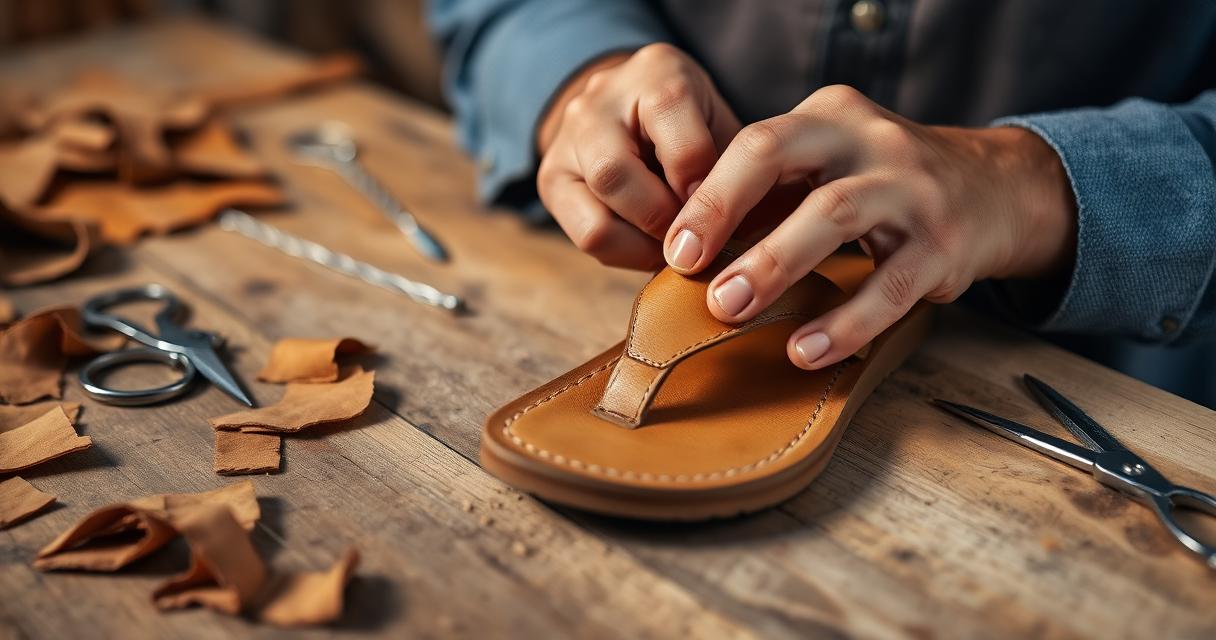
Walk into any large shopping centre in any Pakistani city and you will find shelves of footwear — sandals, mules, slides — priced low, styled attractively, and made somewhere in enormous quantity by processes that have nothing in common with what the word 'shoe' once meant. Then there is handcrafted footwear. The word gets used loosely. This article is an attempt to be specific about what handcrafted footwear actually involves at the making stage, and what it means for your feet, your comfort, and the life of the pair you are buying.
What 'Handcrafted' Actually Means
Handcrafted refers to the involvement of skilled human hands at the stages of production that determine the shoe's fit, durability, and finish. Pattern cutting is done by hand, adjusting for the natural grain and quality of each hide — different from die-cutting that stamps identical panels regardless of variations in the leather.
Edge finishing is done by hand: bevelled, then burnished smooth with heat and friction. A well-finished leather edge is rounded, sealed, and consistent — it will not fray, split, or catch on fabric. A machine-cut, unfinished edge begins to delaminate quickly with regular wear.
Stitching is done by hand or on a smaller machine operated with close oversight, locking each thread in place individually. If one stitch breaks, the remaining stitching holds rather than unravelling — unlike chain-stitch machine sewing, where one broken stitch can pull the entire seam open. Assembly, lasting and final inspection are all decisions made by experienced hands rather than automated stations.
Materials: Why They Matter More Than People Realise
Full-grain leather is the outermost layer of the hide — the strongest, most breathable, and most durable part. It absorbs conditioner, shapes itself slightly to your foot over time, and develops a patina with age that makes it look characterful rather than worn out.
Split leather is taken from inner layers. It is thinner, weaker, has a looser fibre structure, and is often sanded and coated to look like full-grain. The coating peels and the underlying material has nothing like the durability of the real thing.
Bonded leather is not really leather at all — reconstituted fibre mixed with adhesive, pressed into sheets, then surface-coated. It looks like leather at a glance and behaves nothing like it. It typically begins to crack or peel within one season of regular wear. When you buy handcrafted footwear made from full-grain leather, you are buying a material that performs differently at every stage.
What It Does for Your Feet: Adaptation and Breathability
A handcrafted leather sandal made on a quality last adapts to your specific foot over time. Real leather is responsive to pressure, warmth, and moisture. Over weeks of wear, the footbed softens and shapes itself to your arch. Mass-produced synthetic footwear does not do this — it holds its initial shape regardless of how your foot is shaped.
Full-grain leather is breathable. Feet perspire less inside leather footwear than inside synthetic alternatives — fewer blisters, less odour, better skin health on the foot surface over extended wear. In Pakistan's summer heat, this distinction matters considerably.
Foot Support, Posture and Heel Security
A well-constructed footbed — particularly one that has a slight contour following the natural arch — distributes your body weight more evenly than a flat, uniform surface. Over a long day this distribution affects everything from foot comfort to knee and lower back load.
A heel strap or back strap that fits properly keeps the foot anchored in the sandal, preventing the sliding and readjusting that causes calluses on the ball of the foot and blisters at the back of the heel. Proper strap placement is determined in the construction phase — it is a crafted decision, not a default.
The Wellbeing Dimension
There is a dimension to footwear that sits between the physical and the psychological — the way wearing something well-made changes how you move through your day. Uncomfortable footwear draws your attention constantly. You adjust your walking, your standing, your sitting to manage the discomfort.
When footwear fits well and feels right, none of that happens. You are not aware of your feet. Your attention goes to the conversation, the occasion, the task — not to managing your physical discomfort. Over the course of a day, a week, a season, this is the difference between a day spent partly managing your body and a day spent fully inhabiting it.
Craft as Cultural Continuity
In Pakistan, footwear craftsmanship has a lineage — from the chappals of the northwest to the embroidered khussa of Punjab to the fine leather work of Karachi. When a craft is sustained commercially, it continues. When it is undercut by cheap imports, it atrophies. The knowledge held by experienced craftspeople is not written down in a manual; it lives in practice.
Choosing handcrafted footwear made by skilled local craftspeople is a choice to participate in that continuation. When an artisan in Lahore or Karachi makes a pair of leather sandals that lasts you four years, they have produced something more valuable than the fifteen pairs of cheap imports you might have cycled through in the same period.
How to Verify What You Are Buying
Inspect the edges. Genuine handcrafted leather footwear has finished edges — burnished, bevelled, smooth. Run your finger along the cut edge of a strap; if it is smooth and rounded, it has been hand-finished.
Look at stitching consistency. Handcrafted stitching has slight natural micro-variations and follows the leather's edge precisely. Feel the footbed — leather over a quality insole has a slight responsiveness, not the uniform spring of a moulded synthetic. Ask about materials: a brand committed to genuine handcraft can tell you what the upper, lining and sole are made from.
The Honest Calculation
Handcrafted footwear costs more. There is no version of this argument that pretends otherwise. Skilled labour, quality materials, and attentive production are more expensive than the alternative.
The honest calculation is not 'can I afford this pair?' — it is 'can I afford to not have a pair that lasts, fits well, and actually serves my feet?' One pair of handcrafted leather sandals at a higher price point, worn for three to five years, costs less per wear than three or four cheaper pairs cycled through the same period. It is also less wasteful, less disruptive to the craftspeople whose livelihoods depend on sustained demand for quality work, and — measurably — better for your feet.
See the handcrafted edit at Aven by Zoya — made by skilled artisans, built to last. Shop the collection →